

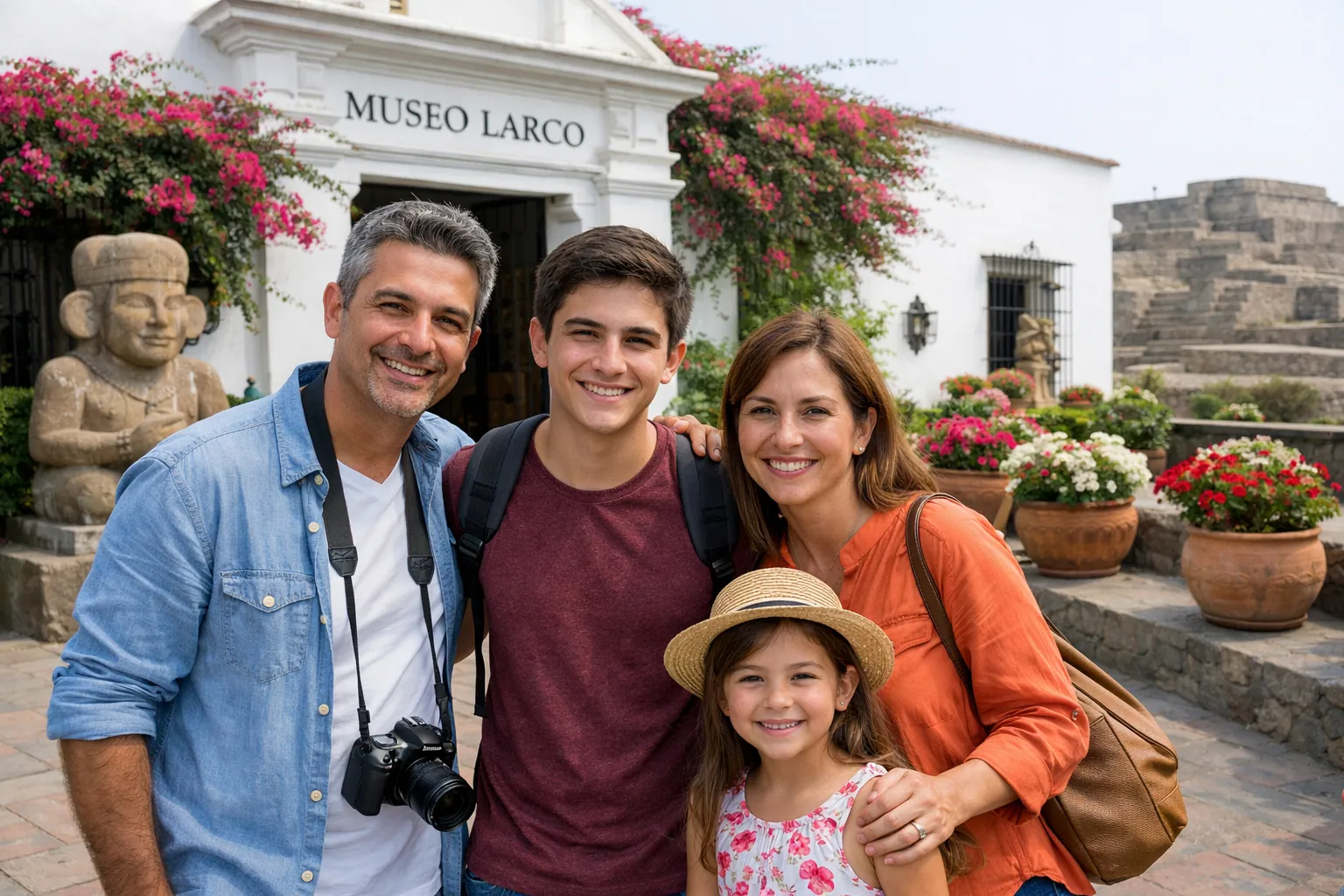
Lima is home to some of the world's finest collections of pre-Columbian art, but none capture the soul of ancient Peru quite like Museo Larco—an intimate place where every object tells a story.
A legacy made visible
The museum began in 1925, when archaeologist Rafael Larco Hoyle inherited approximately 600 ceramic pieces. His meticulous excavations and research created the first comprehensive chronology of Peru's pre-Columbian cultures, still used by archaeologists today.
In 1958, the collection moved into its present home: an 18th-century colonial mansion in Pueblo Libre. Larco's vision was a museum where artifacts would appear not as isolated curiosities, but as chapters in a living narrative.
A colonial oasis
The vice-regal mansion, with adobe walls, wooden balconies and a central courtyard, creates an immediate sense of intimacy. It feels less like an institutional museum and more like an invitation into a grand family home.
Outside, bougainvillea, jasmine and hibiscus transform the gardens into a hidden oasis. They offer a place to reflect after meeting the civilizations that shaped Peru.
Five thousand years of stories
The galleries follow Peru's cultural evolution: Chavín deities and ceremonial vessels; Nazca color and Moche portrait ceramics; Wari textiles with extraordinary geometric precision; Chimú metalwork and coastal life; then the elegant engineering of the Inca.
Each room makes the next destination in Peru feel more meaningful. The textiles, ceramics, goldwork and stone models become a prologue to the Sacred Valley, Cusco and Machu Picchu.
The gallery that invites conversation
The Erotic Art Gallery includes more than 500 Moche ceramics. Rather than treating them as sensational objects, the museum presents them as ritual works that explore fertility, reproduction and the full spectrum of human intimacy.
Its thoughtful curation offers a deeper appreciation for a worldview in which the sacred and sensual, spiritual and physical, were never separate.
Dinner in the gardens
After the galleries, the Great National Pisco Showcase introduces a remarkable collection of Peruvian pisco. A tasting at sunset is followed by dinner in a glass-walled pavilion overlooking the garden.
Causa rellena, lomo saltado, arroz con mariscos and mazamorra morada connect contemporary cooking with the cultures just explored. It is not simply a meal; it is the museum's story continuing through flavor.
The perfect beginning
Museo Larco is an ideal first chapter before a journey through Peru. It turns later sightseeing into storytelling, giving both children and adults a vivid context for the ruins, textiles and traditions they will encounter.
More than a museum, it is a living bridge between history and hospitality—an invitation to fall in love with Peru one ceramic vessel, one garden path and one perfect pisco sour at a time.