
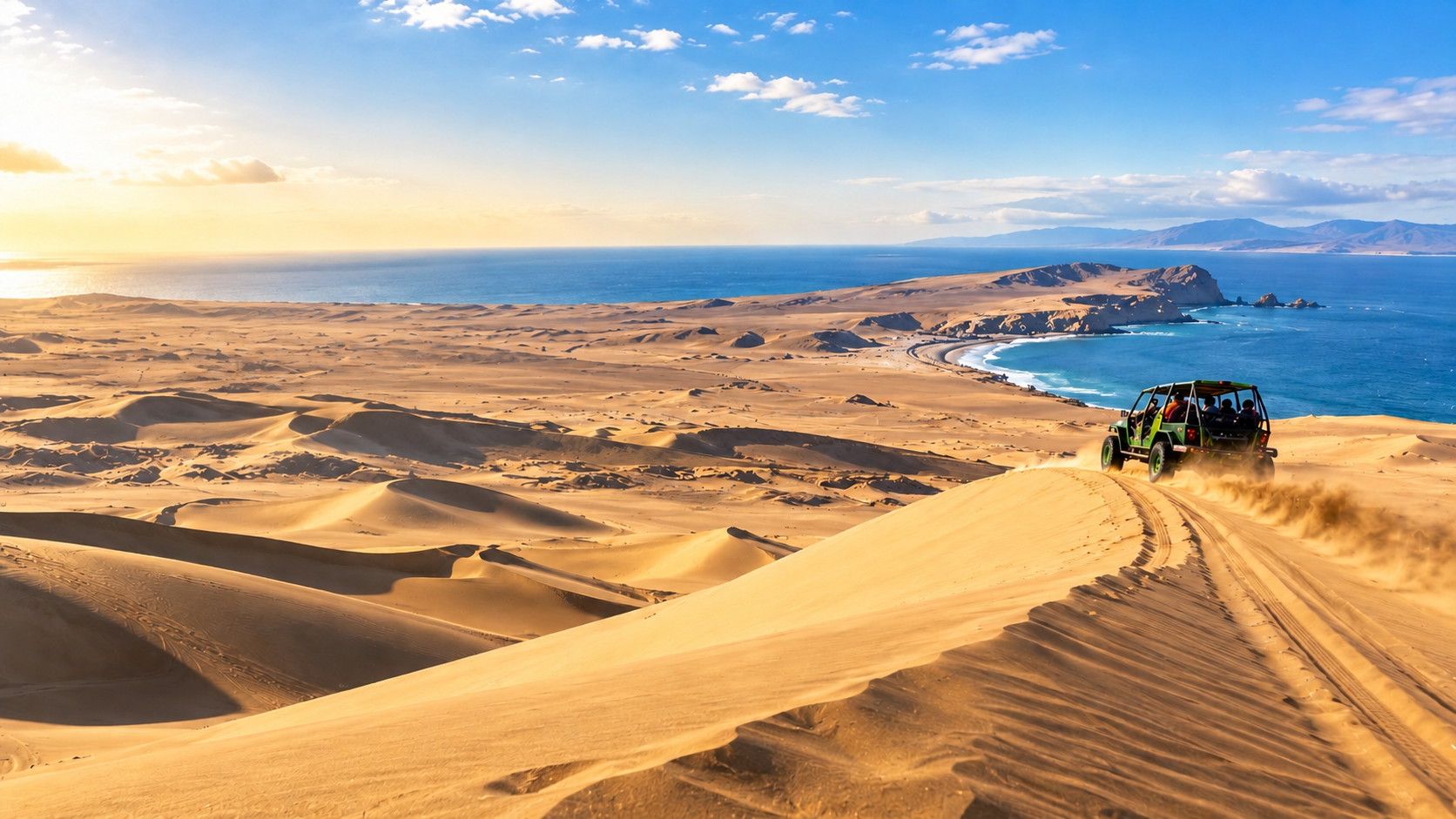

There is a moment when the road seems simply to disappear. Behind you are Paracas, the Pacific coast and the familiar signs of civilization. Ahead, there is only sand—dune after dune rising toward the horizon, sculpted by the wind into enormous golden waves. From a distance, they look almost soft. They aren't. Soon our buggy leaves the flatter desert behind and begins to climb. The engine changes tone, the horizon tilts and sand sprays behind the tires. And suddenly we understand: the desert is not going to be scenery today. We are going inside it.
Discovering the Desert Dunes of Paracas
Peru is famous for the Andes. But along its Pacific coast lies another extraordinary landscape: a vast desert where mountains of sand rise unexpectedly close to the ocean. The desert around Paracas and Ica belongs to one of the driest regions of the Peruvian coast. Wind constantly reshapes the dunes, creating ridges, slopes and valleys that can look completely different depending on the hour and the light.
From the top of a dune, the scale is difficult to understand. There are no buildings to measure against, no trees and sometimes not even another vehicle. Only layers of sand disappearing toward the horizon. We stop at the top of the first major ridge and step out of the buggy. The engine falls silent—and suddenly the desert changes. For a few moments, there is almost nothing but wind, sand and sky. Nobody says very much. The silence seems too large to interrupt.
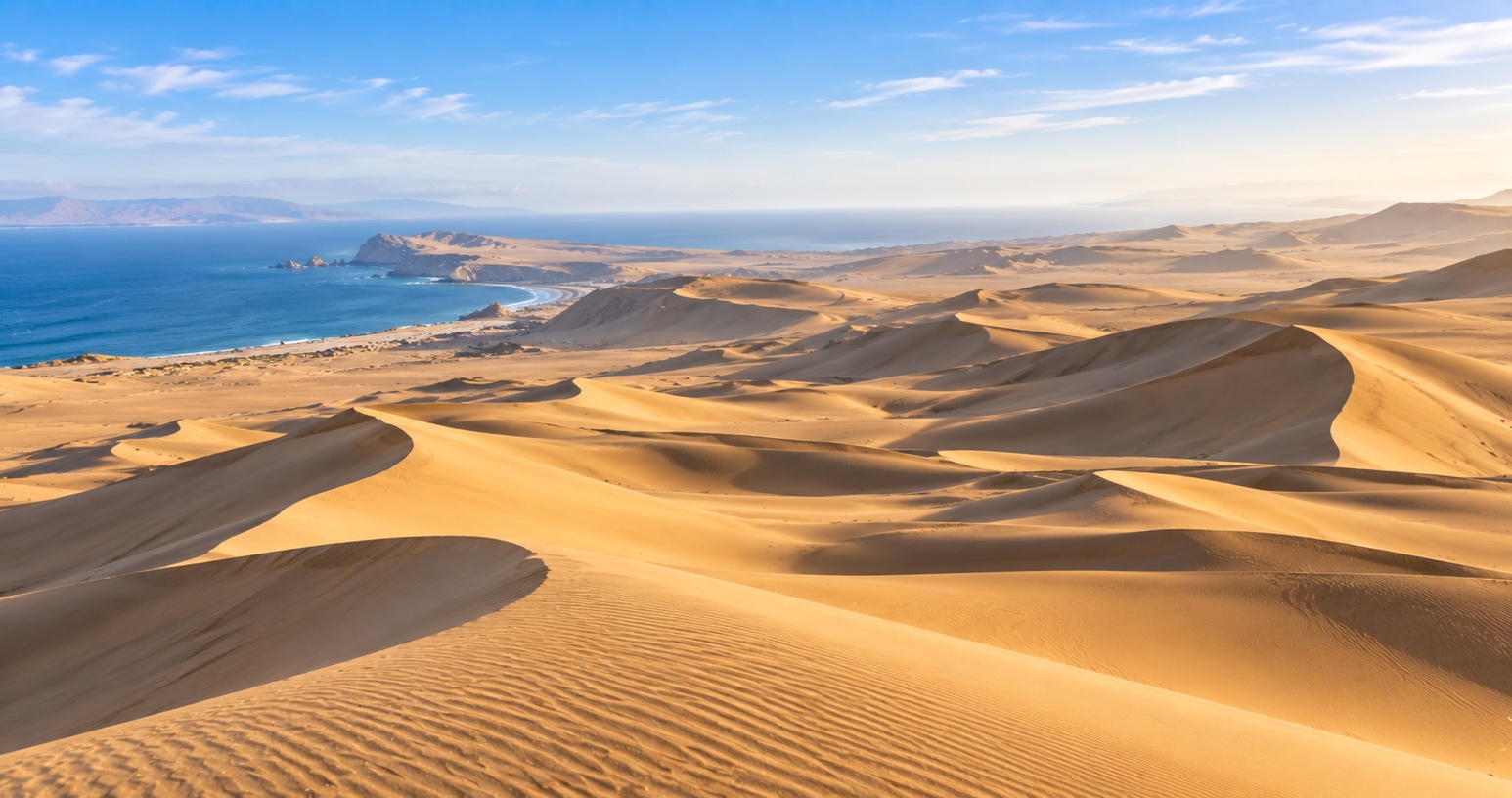
Beyond the Pacific coast, the landscape of Paracas opens into an immense world of wind and sand.
The better-known oasis of Huacachina lies farther inland near Ica, surrounded by its own dramatic dunes and famous for desert adventure. But here, away from the oasis and its crowds, the experience feels different. The desert seems bigger, wilder and, for long stretches, entirely ours. Then our guide opens the back of the buggy and pulls out the boards. The silence is about to end.
Sandboarding in Paracas: Riding the Dunes
There is a moment—just before you push off—when time seems to stop. You stand at the crest of an enormous dune with a slope of untouched sand stretching below you. Your board is ready, and your guide explains what to do. It all sounded perfectly reasonable on flat ground. From up here, somehow, it sounds considerably less reasonable. You look down. Then at your guide. He smiles. That doesn't necessarily help. And then—you go.
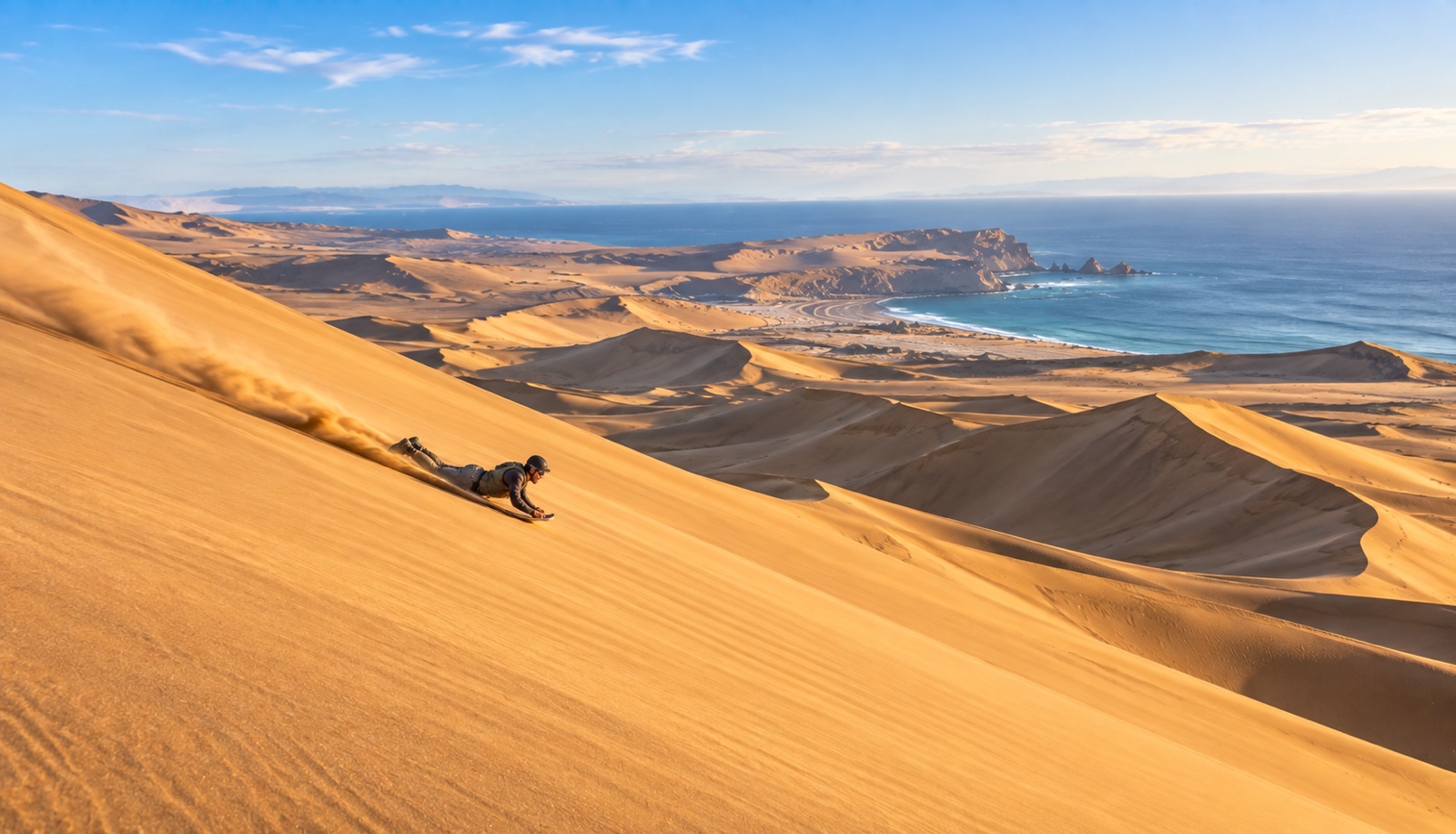
For a few exhilarating seconds, there is nothing between you and the bottom of the dune but gravity.
The first instant is almost silent. Then comes the rush. Wind moves past your ears, sand sprays behind the board and the slope that looked intimidating from above suddenly becomes exhilarating. You quickly discover that sand has its own personality. Some sections are soft and forgiving; others are firmer and faster. Every descent feels slightly different because the wind is constantly rewriting the surface.
Almost before you're ready, you reach the bottom. You stop and look back toward the ridge. Far above is the point where you started, connected to you by a single track carved across what had been perfect sand. You're covered in dust. Your heart is beating faster. And inevitably, you're smiling. The only problem becomes obvious almost immediately. You want to do it again. Fortunately, the buggy is waiting.
Dune Buggy Adventures Across the Paracas Desert
If sandboarding is about surrendering to gravity, the buggy is about discovering what these dunes really look like from inside. You climb aboard, fasten yourself securely and head toward another ridge. Slowly at first—then the dune becomes steeper. The buggy climbs until there is almost nothing visible through the windshield except blue sky. For a fraction of a second at the top, everything seems to pause. Then the desert appears on the other side. And down you go.
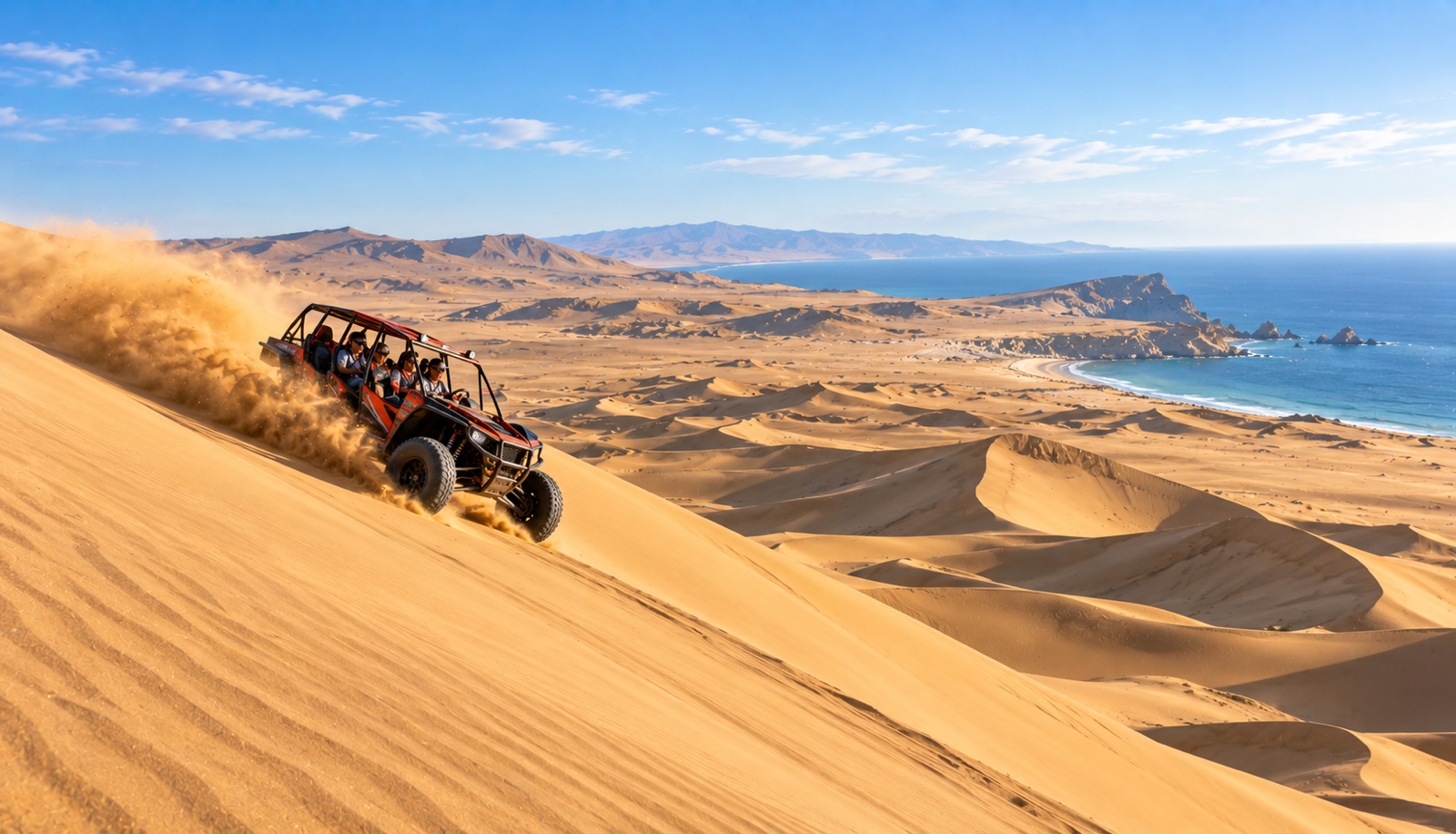
The buggy makes it possible to travel deep into a landscape that would otherwise seem almost inaccessible.
There is adrenaline, certainly. But the best part isn't necessarily the speed. It's the access. The buggy carries you deeper into the desert, across ridges and into valleys where the outside world disappears completely. Every crest reveals something different: enormous smooth curves, sharp ridgelines sculpted by the wind, endless views or hidden hollows surrounded entirely by walls of sand.
A good driver knows how to read this landscape. The dunes change constantly with wind and weather, so driving here isn't simply about following a road. There isn't one. As the afternoon continues, another transformation begins. The light softens, the sand changes from pale gold to amber and long shadows stretch across the ridges. The adventure is slowing down. But the day isn't over.
Sunset and Dinner Among the Dunes
Toward the end of the afternoon, the buggy makes one final journey across the desert. This time, there is no rush. The sun is descending toward the horizon and the dunes have begun to glow. We climb one last ridge and stop. Below us, protected at the bottom of a dune, something completely unexpected appears. A dinner has been prepared in the sand.

After the adrenaline of the afternoon, dinner among the dunes reveals a completely different side of the desert.
Thick rugs lie directly over the sand, soft cushions surround low tables and lanterns begin to glow as daylight fades. After hours of climbing dunes, riding buggies and shaking sand from our shoes, sitting here feels wonderfully improbable. The smell of meat grilling over the fire drifts through the evening air. Dinner is simple, generous and perfectly suited to the setting: grilled meats, accompaniments to share, something cold to drink and absolutely no reason to hurry.
Then the music begins—a surprising blend of Latin rhythms touched by Arabic sounds. Somehow, surrounded by enormous dunes and sitting on carpets beneath an open sky, it feels completely natural. The last sunlight disappears. The temperature drops, conversations become quieter and gradually the stars begin to take over. The buggy that gave us so much adrenaline earlier is no longer the protagonist. Now it is simply our way home. The desert has changed again.
Why the Paracas Desert Stays With You
Perhaps that constant transformation is what makes this experience so memorable. It would be easy to describe it simply as sandboarding, dune buggies, sunset and dinner. But those words don't quite explain it. The real experience is in the contrasts. Noise and silence. Speed and stillness. Adrenaline and contemplation. The enormous openness of the desert followed by the intimacy of sitting together around a table in the sand. Earlier that afternoon, we had stood at the top of a dune wondering whether we really wanted to push ourselves over the edge. Now we were sitting beneath the stars, wishing the evening would last a little longer.
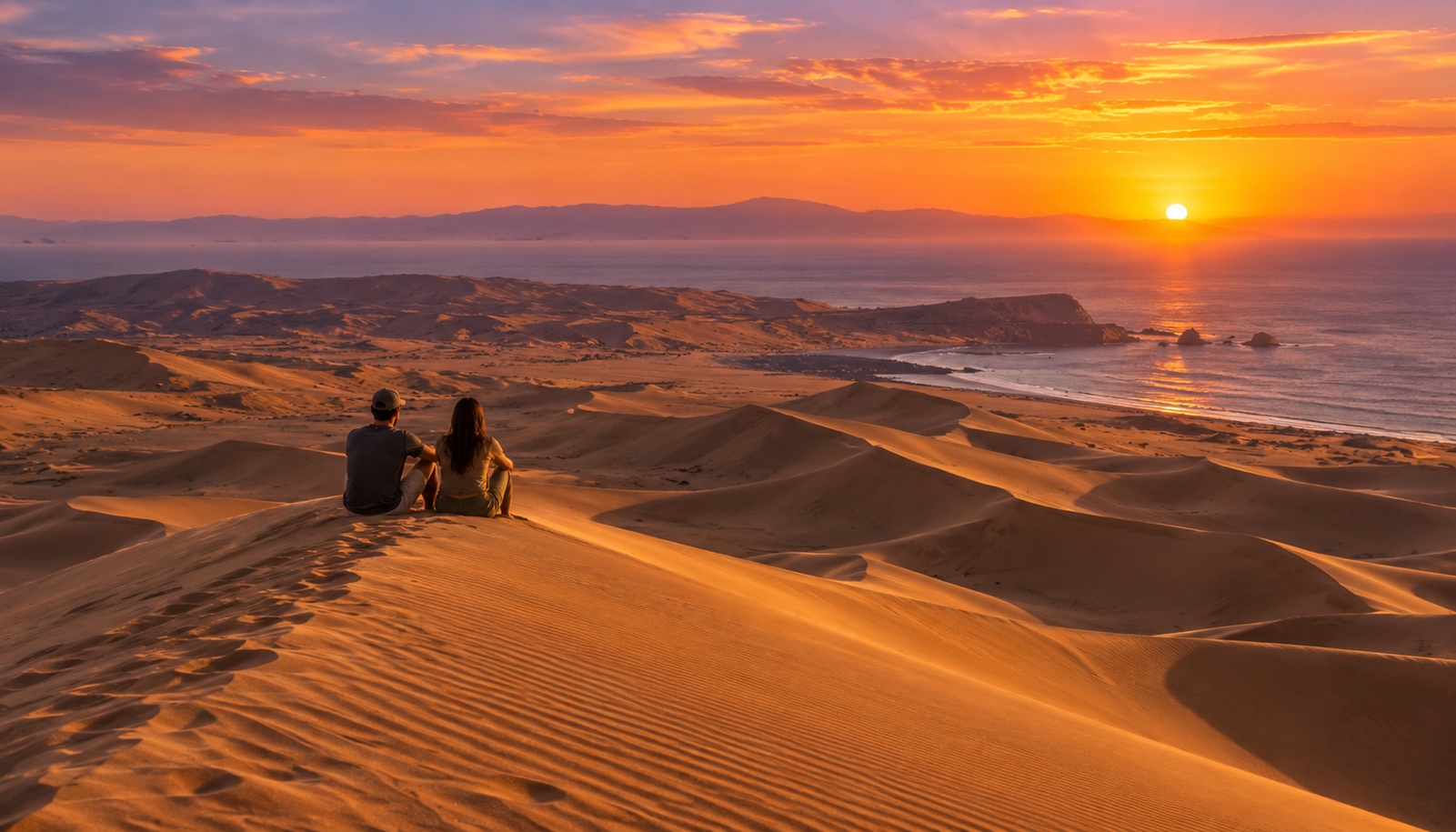
When the engines stop and the light fades, the desert becomes a place of extraordinary stillness.
There's something about the desert that gets under your skin. Perhaps it's because it strips almost everything away. No buildings, traffic or screens demanding your attention. For a while, there is only wind, sand, sky and the people sharing the experience with you. The tracks from our buggy will disappear. The wind will smooth away the lines left by our boards. By tomorrow, perhaps nobody will know we were ever there. But we will. And that may be the strangest thing about the desert:It erases almost every trace you leave behind, while somehow leaving its mark on you.