
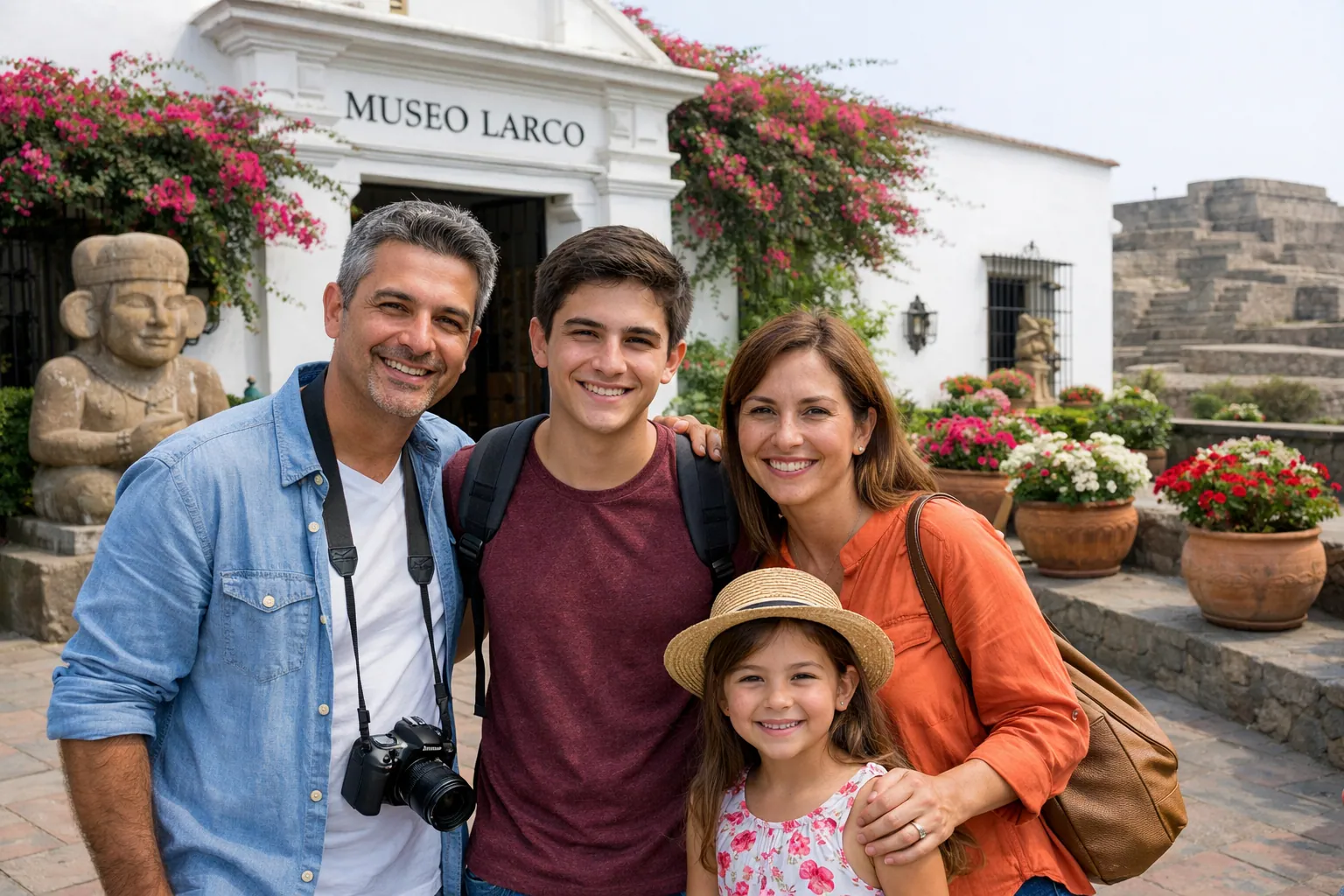

Lima's Pre-Columbian Treasures:A Brief Overview
Lima, Peru's bustling capital, is home to some of the world's finest collections of pre-Columbian art. While the Museo Nacional de Arqueología, Antropología e Historia del Perú in Pueblo Libre offers a comprehensive historical timeline, and the Museo de la Nación showcases massive Moche murals and Chimú artifacts, none capture the soul of ancient Peru quite like the Museo Larco.
Unlike the grand national museums housed in imposing government buildings, the Museo Larco feels intimate—like stepping into a collector's private sanctuary where every object tells a story, and every room invites you to linger.
The Birth of a Legacy:Rafael Larco Hoyle's Vision
The Museo Larco's story begins in 1925, when Rafael Larco Hoyle, a young Peruvian archaeologist and entrepreneur, inherited a collection of approximately 600 ceramic pieces from his uncle, Victor Larco Herrera. What began as a family passion project would evolve into one of Latin America's most important archaeological museums.
Rafael Larco Hoyle was not merely a collector—he was a scholar who revolutionized our understanding of Peru's ancient cultures. Through meticulous excavation and study, he developed the first comprehensive chronology of Peruvian pre-Columbian cultures, a framework still used by archaeologists today. His groundbreaking work identified distinct cultural periods—from the Cupisnique and Chavín to the Moche, Nazca, Wari, Chimú, and Inca—each with its own artistic style, religious beliefs, and technological achievements.
In 1926, Larco Hoyle opened his collection to the public in a small space in Lima. But he dreamed of something greater: a museum where artifacts could be displayed not as isolated curiosities, but as chapters in a living narrative.
That dream found its home in 1958, when the collection moved to its current location—an 18th-century colonial mansion in the Pueblo Libre district, surrounded by lush gardens that would become an integral part of the experience.
What Sets Museo Larco Apart:Location, Architecture, and Ambiance A Colonial Oasis in the City
Unlike Lima's national museums, which occupy modern or institutional buildings, the Museo Larco is housed in a beautifully preserved vice-regal mansion dating back to 1760. The building itself is a historical artifact—a testament to Spanish colonial architecture with its thick adobe walls, wooden balconies, and central courtyard.
This setting creates an immediate sense of intimacy. You don't feel like you're visiting a museum; you feel like you've been invited into a grand family home where treasures have been lovingly curated across generations.
The Gardens:Where History Meets Serenity
Perhaps the most magical aspect of Museo Larco is its tropical gardens—a hidden oasis in the heart of Lima where bougainvillea cascades over stone walls, jasmine perfumes the air, and hummingbirds dart between hibiscus blooms.
These gardens aren't just decorative; they're an extension of the museum experience. After hours spent contemplating ancient civilizations, the gardens offer a space to reflect, to breathe, and to transition gently from the past back to the present.
And nestled within these gardens lies one of Lima's best-kept secrets: the Museo Larco Restaurant, where Peruvian cuisine meets archaeological elegance in a setting that feels both timeless and transcendent.
A Journey Through Time:The Museum's Narrative Rooms Gallery 1: Formative Period (1250 BCE – 200 CE)
Your journey begins in darkness—literally. The first gallery is dimly lit, evoking the mystery of Peru's earliest civilizations. Here, Chavín de Huántar artifacts dominate: stone carvings of feline deities with snarling mouths and serpentine hair, ceramic vessels depicting shamanic transformations, and the iconic Lanzón Stela replica—a towering granite figure that once stood at the heart of Chavín's temple complex.
The lighting is deliberate. Spotlights illuminate each piece like sacred relics, inviting you to lean closer, to study the intricate details that reveal a worldview where humans, animals, and gods existed in fluid communion. You can almost hear the echoes of ancient rituals—the chanting of priests, the blowing of conch shell trumpets, the scent of burning copal incense.
Gallery 2:Regional Developments (200 BCE – 600 CE)
As you move forward in time, the museum's narrative expands geographically. This gallery showcases the incredible diversity of Peru's regional cultures during a period when no single empire dominated.
Nazca pottery explodes with color and creativity: vessels shaped like orcas, monkeys, and mythical beings, painted in bold reds, blacks, and whites. Nearby, Moche ceramics reveal a different aesthetic—one of startling realism and psychological depth. Moche portrait vessels stare back at you with individualized faces: a warrior with a scar across his cheek, an elder with wrinkles etched by time, a priest with an expression of serene authority.
What's remarkable about this gallery is how it demonstrates that Peru's ancient peoples weren't isolated—they were in constant dialogue, exchanging ideas, techniques, and beliefs across vast distances.
Gallery 3:The Wari Empire (600 – 1000 CE)
The Wari room marks a shift in scale and ambition. Here, you encounter the first true empire of the Andes—a civilization that pioneered administrative systems, road networks, and standardized artistic styles centuries before the Inca.
Wari textiles are the stars of this gallery. Woven from alpaca and vicuña fibers, these textiles feature geometric patterns so complex they required mathematical precision. Some designs repeat across hundreds of miles, evidence of a centralized artistic program that unified diverse peoples under Wari rule.
Standing before these textiles, you can't help but marvel at the patience and skill required to create them. Each thread represents hours of work; each pattern encodes cultural knowledge passed down through generations.
Gallery 4:Chimú and Coastal Kingdoms (900 – 1470 CE)
The Chimú gallery immerses you in the world of Chan Chan—the largest adobe city in the Americas and capital of a coastal empire that stretched for hundreds of miles along Peru's northern coast.
Chimú metalwork dazzles with sophistication: gold and silver nose ornaments, ear spools, and ceremonial knives (tumi) that demonstrate mastery of lost-wax casting and alloy techniques. But what's most striking is the Chimú's relationship with the sea. Ceramic vessels depict fishermen in reed boats, sea lions playing in waves, and seabirds diving for fish—reminders that this was a civilization intimately connected to the Pacific Ocean.
Gallery 5:The Inca Empire (1400 – 1532 CE)
The final pre-Columbian gallery belongs to the Inca—the empire that would ultimately unite all of Peru under a single banner.
Inca artifacts are deceptively simple compared to their predecessors. Their ceramics are elegant but restrained, their textiles precise but understated. This simplicity reflects Inca philosophy: beauty lay not in ornamentation but in perfection of form and function.
But don't mistake simplicity for lack of sophistication. Inca stonework—represented here by miniature models of Machu Picchu and Sacsayhuamán—reveals engineering genius. Stones fit together so precisely that not even a blade of grass can slip between them. Walking past these models, you can't help but feel anticipation for the real thing waiting in Cusco and the Sacred Valley.
The Erotic Art Gallery:Peru's Most Misunderstood Treasure
Tucked away in a separate wing of the museum lies what many visitors consider the highlight of their visit: the Erotic Art Gallery.
This collection of over 500 Moche ceramic vessels depicting explicit sexual acts has captivated—and sometimes scandalized—visitors for decades. But to dismiss these pieces as mere pornography is to miss their profound cultural significance.
For the Moche people, sexuality was sacred. These vessels weren't created for titillation; they were ritual objects that celebrated fertility, honored deities associated with reproduction, and explored the full spectrum of human intimacy—from tender embraces to same-sex relationships to acts involving animals and supernatural beings.
What's remarkable about this gallery is its matter-of-fact presentation. There's no judgment, no sensationalism—just careful curation that invites you to consider how different cultures understand and represent the human body. Children often visit this gallery with their parents, and the museum provides educational materials that contextualize the pieces within Moche cosmology.
Leaving this gallery, you carry with you a deeper appreciation for the complexity of ancient Peruvian worldviews—worldviews that saw no contradiction between the sacred and the sensual, the spiritual and the physical.
The Perfect Culmination:Bar and Restaurant in the Gardens
After two or three hours immersed in Peru's ancient past, you emerge into the museum's tropical gardens—and time seems to slow.
Before dinner, step into the museum's elegant bar: the Great National Pisco Showcase, an exhibition featuring over one thousand bottles from different brands of Peruvian pisco. This one-of-a-kind exhibition exists nowhere else in the world—a lifetime passion project born from decades of meticulously collecting Peru's national spirit.
Whether you prefer the floral notes of a Mosto Verde, the robust character of an Acholado, or the pure expression of a Puro, the bartenders here are passionate educators who will guide you through tastings that reveal pisco's incredible diversity. Sip your chosen variety in a crystal copita as the sun begins to set, casting golden light across the gardens.
The Restaurant: Peruvian Cuisine Meets Archaeological Elegance.
Dinner at the Museo Larco Restaurant is more than a meal—it's an extension of the museum experience.
The restaurant occupies a glass-walled pavilion overlooking the gardens, where candlelight flickers on white linen and the gentle murmur of conversation blends with the chirping of crickets. The menu celebrates Peru's culinary heritage with dishes that echo the civilizations you've just explored:
Causa Rellena—a layered potato dish that honors Peru's incredible diversity of tubers (over 4,000 varieties!).
Lomo Saltado—a fusion dish that acknowledges Peru's multicultural history.
Arroz con Mariscos—a seafood rice that pays tribute to coastal cultures like the Moche and Chimú.
Mazamorra Morada—a purple corn pudding that connects modern Peru to its ancient agricultural roots.
Each dish arrives on handcrafted ceramic plates that echo pre-Columbian designs, creating a dining experience that feels both contemporary and timeless.
As you dine beneath the stars, surrounded by the same gardens that Rafael Larco Hoyle once walked, you understand that this museum isn't just about preserving the past—it's about bringing it to life in ways that nourish body and soul.
The Perfect Preludeto Your Peruvian Journey
Visiting the Museo Larco before traveling to Cusco, the Sacred Valley, Lake Titicaca, and Machu Picchu is like reading the prologue to an epic novel. The museum provides essential context that transforms your subsequent travels from sightseeing into storytelling.
When you stand before the Moche portrait vessels, you'll recognize the same artistic sensibility in the terracotta figurines sold in Cusco's markets. When you study the Wari textiles, you'll appreciate the continuity of weaving traditions still practiced by Quechua women in the Sacred Valley. When you examine the Inca stonework models, you'll understand the engineering marvels awaiting you at Sacsayhuamán and Ollantaytambo.
For children especially, the museum serves as an engaging introduction to Peru's ancient civilizations. The realistic Moche faces capture their imagination; the colorful Nazca pottery sparks curiosity; the gold artifacts inspire wonder. By the time you reach Machu Picchu, your children won't just see ruins—they'll see the culmination of a story that began thousands of years ago.
An EducationalExperience for All Ages
The Museo Larco excels at making archaeology accessible without sacrificing depth. Interactive displays allow visitors to handle replica artifacts; multilingual audio guides provide context without overwhelming; and the chronological layout ensures that even first-time visitors can follow Peru's cultural evolution.
For families, the museum offers special programs where children can participate in mock archaeological digs, create their own ceramic vessels using ancient techniques, and learn about the plants and animals that sustained Peru's ancient civilizations. These hands-on experiences transform abstract history into tangible understanding.
Conclusion:More Than a Museum—A Living Bridge
The Museo Larco + dinner in the gardens is more than a Lima attraction—it's a living bridge between past and present, between education and enjoyment, between history and hospitality.
It's where you can spend an afternoon contemplating 5,000 years of human creativity, then transition seamlessly into an evening of culinary delight beneath the stars. It's where children discover that history isn't boring—it's full of fascinating faces, colorful stories, and surprising secrets. It's where adults rediscover the wonder of human achievement and the beauty of cultural continuity.
As you leave the museum, full of pisco and lomo saltado, carrying with you images of Moche warriors and Inca stonemasons, you carry something more valuable than souvenirs: a deeper understanding of the land you're about to explore, and a profound appreciation for the civilizations that shaped it.
The Museo Larco doesn't just prepare you for Peru—it invites you to fall in love with it, one ceramic vessel, one garden path, one perfect pisco sour at a time.